
Blog
Mini Recessed LED Downlights: Maximum Lighting in Minimal Architectural Space
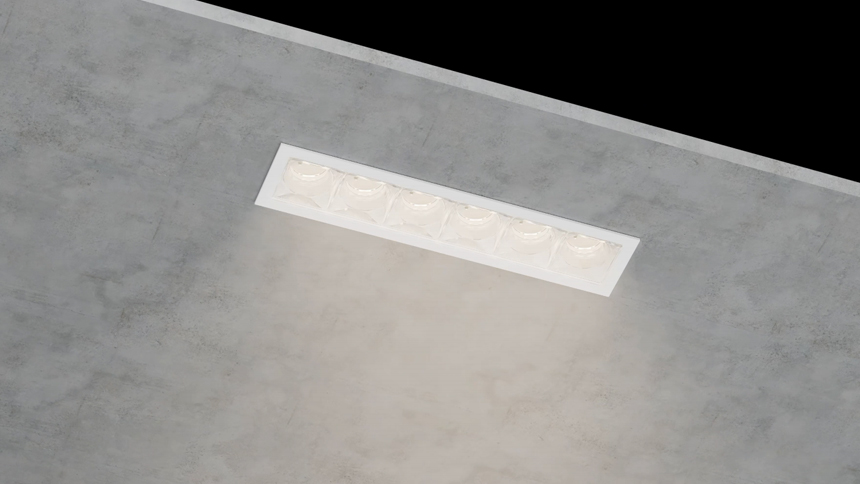
Mini Recessed LED Downlights: Maximum Lighting in Minimal Architectural Space

Joyce Alva.UpdatedNovember 12, 2026|8 mins Read
In contemporary architecture, less is often more.
As spaces become cleaner, more refined, and increasingly integrated, lighting is expected to do more while becoming less visible. Large fixtures, bulky housings, and visually dominant luminaires are gradually giving way to lighting solutions that disappear into the architecture, leaving the light itself to define the space.
This is where mini recessed LED downlights come into their own. Small in size but highly capable, mini recessed downlights provide a precise way to introduce light into spaces where every millimeter matters. They can highlight architectural details, create visual hierarchy, support functional lighting, and enhance material textures without competing with the surrounding design.
But miniaturization alone does not make a downlight suitable for architectural applications. The real challenge is achieving the right balance between compact dimensions, optical performance, visual comfort, installation flexibility, and architectural integration.
Why Mini Recessed Downlights Are Becoming More Important
Lighting design has evolved from simply illuminating a room to shaping how a space is perceived.
In minimalist interiors, this becomes particularly important. When architectural forms are intentionally reduced to their essentials, even a small visible fixture can interrupt the visual language of the space. Traditional recessed downlights can provide excellent illumination, but their larger apertures and deeper housings may not always work within compact ceilings, narrow corridors, furniture details, or highly controlled architectural compositions.
Mini recessed LED downlights offer another approach.
Their smaller aperture allows lighting to be integrated into the ceiling with minimal visual presence. When carefully specified, the result is not a ceiling filled with fixtures, but a space where light appears to come naturally from the architecture. This makes mini recessed downlights particularly relevant to high-end residential interiors, boutique hotels and hospitality spaces, luxury retail environments, restaurants and fine dining spaces, galleries and museums, offices and executive spaces, corridors and circulation areas, display and feature lighting, and compact architectural details.
The smaller the luminaire becomes, however, the more important its engineering becomes. A compact downlight must still deliver sufficient output, controlled beam distribution, good color quality, and comfortable visual performance. Otherwise, reducing the physical size simply means compromising the quality of light.
The objective is therefore not simply “smaller lighting.” It is maximum lighting performance within minimum architectural space.
Small Aperture, Strong Architectural Presence
One of the greatest advantages of mini recessed downlights is their ability to minimize the physical presence of lighting. A conventional downlight can become part of the visual composition of a ceiling. A mini recessed downlight can instead become almost invisible within it.
This difference is particularly valuable in minimalist architecture. Consider a clean hotel corridor with a continuous ceiling plane. A series of large downlights can create a repetitive visual pattern, while a smaller recessed aperture allows the ceiling to remain visually continuous.
This is one of the fundamental principles of architectural lighting. The fixture should support the architecture, not compete with it. Mini recessed downlights make this principle easier to achieve.
1. Maximum Lighting Performance from a Minimal Footprint
Reducing the size of a luminaire naturally creates a technical challenge. A smaller housing means less physical space for the LED, optics, heat dissipation, and mechanical components. Yet architectural lighting still demands reliable performance. A well-designed mini recessed downlight therefore needs to optimize several elements simultaneously.
Optical efficiency
The optical system needs to make effective use of the available light output. Instead of simply producing more lumens, the luminaire should deliver light where it is actually needed.
Beam control
A precise beam angle allows designers to determine how light interacts with walls, furniture, artwork, or other architectural elements. Narrow beams can create focused accents, while wider beams can provide softer and more uniform illumination.
Thermal management
Even compact LED luminaires generate heat. Efficient thermal design is essential for maintaining performance and reliability over time.
Color quality
For premium architectural environments, light quality is often more important than raw lumen output. High CRI performance can help materials, finishes, fabrics, artwork, and skin tones appear more naturally.
Glare control
As the luminaire becomes smaller, controlling the relationship between the light source, optical system, and viewer becomes increasingly important.
The best mini recessed downlight is therefore not simply the smallest one available. It is the one that makes the most effective use of a limited physical footprint.
2. Beam Angles: Designing with Light Rather Than Fixtures
Mini recessed downlights are particularly powerful when used as tools for shaping space. Beam angle is one of the most important variables.
A narrow beam can concentrate light onto a specific object or surface, making it suitable for artwork, sculptures, decorative objects, retail displays, feature walls, and architectural details. A wider beam distributes light across a larger area and can be used for general illumination, circulation areas, living spaces, hospitality interiors, and work spaces.
But beam angle should not be considered independently.
The distance between the luminaire and the illuminated surface, ceiling height, mounting position, surface reflectance, and desired visual effect all influence the final result.
For example, a narrow beam installed too close to a wall may create a concentrated hotspot, while a wider beam installed too far from a feature may produce insufficient visual emphasis. This is why professional lighting design often begins with the desired lighting effect, rather than simply selecting a fixture based on wattage.
The question is not: “How many downlights do we need?” It is: “Where should the light go?”
3. Mini Downlights for Different Architectural Applications
The flexibility of mini recessed LED downlights makes them suitable for a wide range of architectural environments.
Residential Lighting
In high-end residential projects, lighting needs to adapt to different activities and moods. A single living room may function as a social space, a reading area, an entertainment zone, and a place for relaxation.
Mini downlights can provide focused illumination without visually overwhelming the interior. They can be positioned above furniture, artwork, circulation routes, or architectural features while maintaining a clean ceiling appearance.
In bedrooms and private spaces, low-glare options can contribute to a softer and more comfortable atmosphere.
Hospitality Lighting
Hotels require lighting that performs across multiple layers. Guest rooms need comfort and flexibility. Corridors need orientation. Restaurants need atmosphere. Lobbies need visual impact.
Mini recessed downlights can be used as part of a layered lighting strategy, working alongside indirect lighting, linear lighting, wall washing, and decorative fixtures. Because the luminaires occupy minimal visual space, they are particularly useful in luxury hospitality environments where interior materials and architectural details are intended to remain the primary focus.
Retail Lighting
Retail environments rely heavily on visual presentation. Products need to attract attention without making the lighting system itself the focus. Mini recessed downlights can provide precise accent lighting for merchandise, displays, shelving, and architectural elements.
Different beam angles can be selected according to the size and position of the objects being illuminated, allowing the lighting system to evolve with the retail environment.
Art Galleries and Museums
For galleries and museums, light quality and control become even more critical. Artwork may require highly controlled illumination to reveal texture and color while minimizing unwanted glare.
Compact recessed luminaires can be integrated into the ceiling architecture and positioned to direct light toward selected pieces without introducing unnecessary visual elements. In these applications, color quality, beam control, glare management, and precise positioning all become essential.
4. Installation Flexibility Matters
A mini downlight may be small, but installation requirements can vary considerably from one project to another. Different ceiling structures, depths, materials, and architectural details can create different constraints.
For this reason, designers should consider more than the visible aperture. Important factors include recessed depth, cut-out dimensions, ceiling construction, driver arrangement, adjustable or fixed installation, tilt range, beam angle, maintenance accessibility, and installation density.
For projects with limited ceiling depth, a compact luminaire can make the difference between a clean installation and a compromise in architectural detailing.
Adjustable mini downlights can provide even greater flexibility. Instead of directing every fixture straight downward, adjustable versions allow designers to redirect light toward walls, artwork, furniture, or other visual targets. This transforms the downlight from a simple ceiling fixture into a precision lighting tool.
What to Consider When Choosing Mini Recessed LED Downlights
With so many compact lighting products available, specification should go beyond dimensions and wattage. Here are several factors worth considering.
1. Aperture size
A smaller aperture generally provides a more discreet appearance, but it should not come at the expense of optical performance.
2. Lumen output
The required output depends on the application, mounting height, beam angle, and target illuminance.
3. CRI
For hospitality, residential, retail, and display environments, high color rendering can be important for maintaining the appearance of materials and objects.
4. Beam angle
Choose the beam according to the intended lighting effect rather than simply selecting the widest or narrowest option.
5. Glare performance
Consider the viewing angle, cut-off, optical structure, and overall UGR performance where relevant.
6. Adjustability
For accent applications, tilt and rotation can significantly increase design flexibility.
7. Ceiling compatibility
Check the cut-out, installation depth, ceiling thickness, and driver requirements before finalizing the specification.
8. Dimming and control
Modern projects may require integration with different lighting control systems, so compatibility should be considered early in the design process.
9. Consistency
When multiple luminaires are installed together, consistency in color temperature, beam distribution, and optical performance is essential to maintaining a coherent lighting effect.
Ultimately, the best solution is the one that balances architectural discretion with optical precision.
Maximum Lighting, Minimal Architectural Presence: COLORS Mini Downlights
The demand for smaller lighting fixtures reflects a broader change in architectural lighting. As spaces become more refined, the lighting itself needs to become more integrated.
At COLORS Lighting, our approach to compact recessed lighting focuses on balancing a minimal physical footprint with the performance required for professional architectural applications.
The goal is not simply to make a downlight smaller. It is to make the lighting solution more discreet, more precise, and more adaptable to the architecture. By reducing the visual footprint of the luminaire, designers gain more freedom to arrange lighting according to the architecture rather than according to a fixed fixture grid.
Compact lighting is particularly effective when the purpose of the fixture is clearly defined. For general illumination, designers may prioritize efficient and comfortable light distribution. For accent applications, a more focused beam may be required.
COLORS' downlights portfolio includes different optical approaches for these varied requirements.
The GENIE 2S, for example, combines CRI 90 with a 45° anti-glare design and a 9° beam option, making it suitable for applications where controlled accent lighting and high color quality are important. For projects requiring high efficiency together with strong glare control, KING2 provides up to 115 lm/W with UGR <1. Meanwhile, QUEEN provides a smaller 45 mm aperture with up to 110 lm/W and UGR <13, offering designers another option where a discreet ceiling presence is important.
These products illustrate an important principle: compact lighting does not have to mean compromised lighting.
From Mini Downlights to a Complete Architectural Lighting System
A project rarely depends on one type of fixture.
A hotel may combine mini recessed downlights with linear lighting, decorative fixtures, track systems, and concealed illumination. A penthouse may use compact downlights for accent lighting while linear systems provide indirect ambient illumination. A restaurant may combine focused downlights with decorative pendants and architectural wall lighting.
The role of a mini downlight is therefore not to replace every other lighting solution. It is to provide a precise and discreet layer within a broader lighting system. COLORS develops architectural lighting solutions across different applications, allowing designers to build a more consistent lighting language across a project.
The fixture can remain subtle. The light can remain purposeful. Mini recessed LED downlights represent more than a trend toward smaller fixtures. They reflect a broader shift in architectural lighting, from visible luminaires toward integrated lighting systems.
As ceilings become cleaner and architecture becomes more refined, lighting needs to work harder without becoming more visually dominant. That means controlling glare. Maintaining color quality. Delivering useful illumination. Managing heat. Supporting dimming and control.
And, above all, integrating with the architecture. The most successful mini downlight is not necessarily the smallest one. It is the one that achieves the right balance between size, performance, precision, and visual presence. At COLORS Lighting, we continue to develop architectural lighting solutions around this balance — creating compact products that allow designers to use light more freely while keeping the architecture visually clean. Because sometimes, the most powerful lighting element is the one you barely see.
Small in form. Precise in performance. Designed around the architecture.
Related Content
View All
Outdoor Recessed Downlights: IP65 Rated for Weatherproof Performance
Joyce Alva
9 mins Read

360 Neon Flex: A Complete Guide for Architectural & Commercial Lighting Projects
Aurora Jin
9 mins Read

What Are The Main Lighting Methods And Products Used In Architectural Facade Lighting?
Ryan Lee
8 mins Read
Dynamic Façade Lighting – 11 Technical Highlights on DMX512 RGB Neon Strip Applications
Ryan Lee
9 mins Read