Blog
What is the Difference Between Spotlight and Downlight?
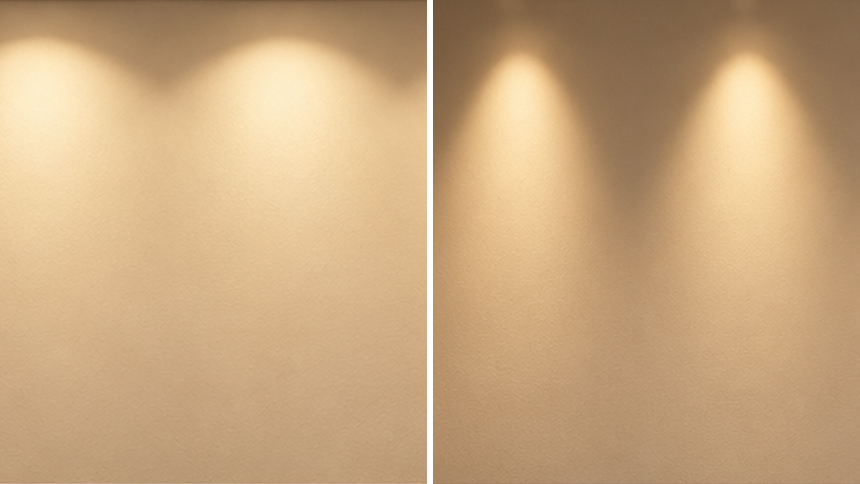
What is the Difference Between Spotlight and Downlight?

Joyce Alva.UpdatedSeptember 17, 2026|13 mins Read
Lighting is one of the most important elements in interior and architectural design. It does much more than simply make a space bright. The right lighting can guide people's attention, create atmosphere, highlight products and artwork, define different areas, and even influence how a room feels.
Among the many lighting fixtures used in modern spaces, spotlights and downlights are two of the most common. They can both be found in homes, hotels, restaurants, retail stores, museums, offices, and commercial spaces.
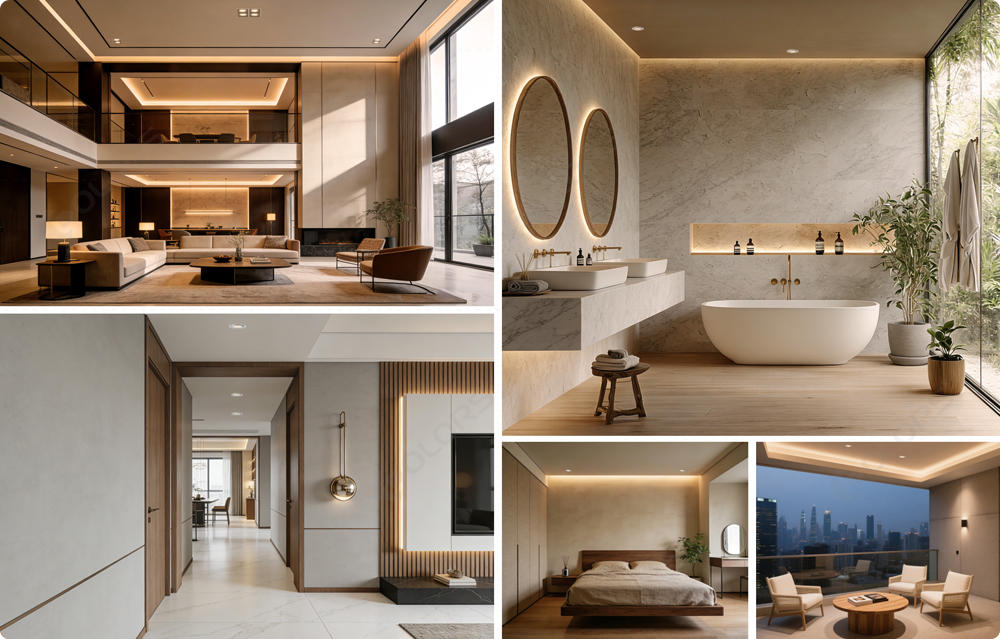
At first glance, they may look quite similar. Both can be compact, LED-based, and installed in ceilings. Both can provide directional light, and both are frequently used in professional lighting projects. So, what exactly is the difference between a spotlight and a downlight? Can you tell which one is a spotlight and which one is a downlight just by looking at them?
The answer is not always obvious. The biggest difference is not simply their appearance, but how they direct light, what they are designed to illuminate, and how they are used within a lighting scheme.
A traditional recessed downlight and a track-mounted spotlight are easy to distinguish. However, modern architectural lighting has become increasingly diverse. Adjustable downlights, gimbal downlights, recessed spotlights, and directional downlights can have very similar appearances and overlapping applications.
Therefore, the difference should be understood from several perspectives, including structure, light direction, adjustability, optical design, installation, and application.
What Is a Spotlight?
A spotlight is a lighting fixture designed primarily to produce focused and directional illumination.
The name itself provides an important clue: a spotlight is intended to "spot" light onto a specific area, object, or feature. Instead of distributing light evenly throughout a space, a spotlight concentrates its light into a relatively defined beam.
For example, imagine a retail store displaying a new product. Instead of illuminating the entire store equally, a spotlight can direct a concentrated beam toward that product, making it visually stand out.
The same principle applies to museums and galleries. A spotlight can be aimed at a painting, sculpture, or exhibition object, helping draw the visitor's attention toward it.
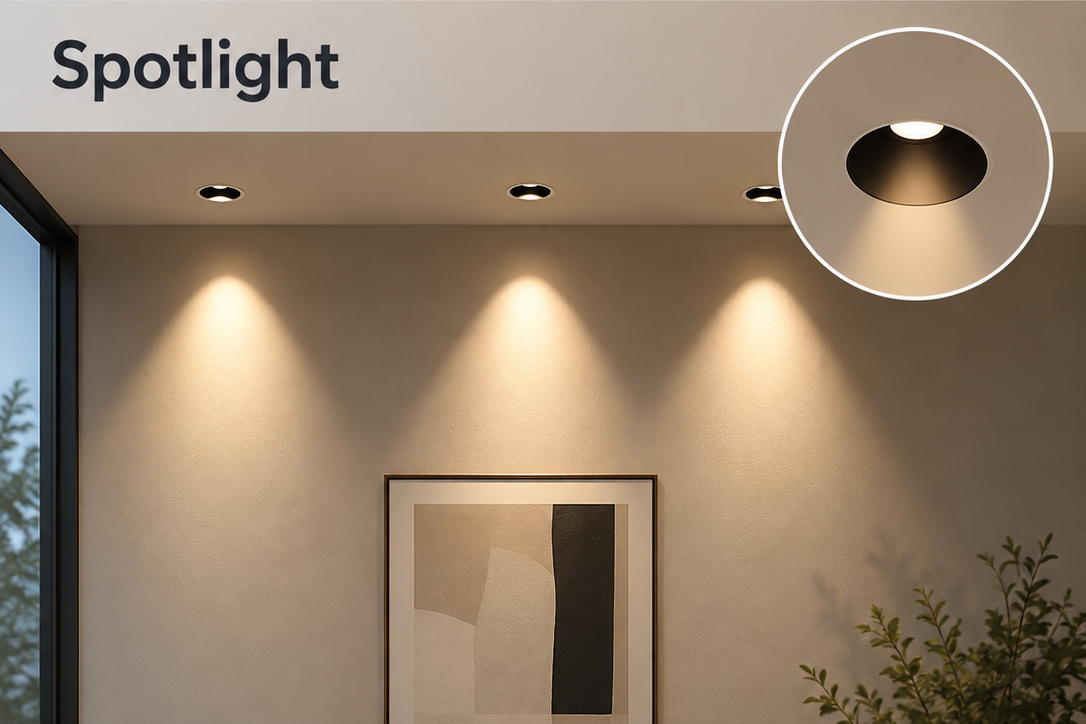
Key Features of Spotlights
1. Directional Light
The most important feature of a spotlight is its directional nature. The light is designed to travel toward a specific target rather than simply illuminating the area directly beneath the fixture. This makes spotlights particularly suitable for accent and highlight lighting.
2. Narrow or Controlled Beam Angles
Spotlights often use relatively narrow or controlled beam angles. A narrow beam can create a concentrated pool of light, while a wider spotlight beam can illuminate a larger target area. The choice depends on the size and distance of the object being illuminated.
3. Adjustable Direction
Many spotlights can be tilted or rotated. This is one of their most recognizable characteristics. An adjustable spotlight allows designers to change the lighting direction after installation. This is particularly useful in environments where displays or interior layouts change regularly.
For example, a retail store may rearrange its products every few weeks. Adjustable spotlights allow the lighting to follow the new layout without requiring the fixtures to be relocated.
4. Strong Accent-Lighting Capability
Spotlights are particularly effective when the purpose of lighting is to attract attention. They can emphasize artwork, products, architectural details, decorative objects, furniture, textures, signage, and merchandise displays.
This makes them an important tool for creating visual hierarchy within a space.
5. Flexible Installation
Spotlights can be installed in different ways. Depending on the product, they may be track-mounted, surface-mounted, recessed, ceiling-mounted, and wall-mounted.
Track spotlights are particularly popular in retail environments because multiple fixtures can be installed on the same track while each light is aimed at a different target.
Applications of Spotlights
Because of their directional nature, spotlights are widely used for accent and display lighting.
Retail Stores
Retail lighting is one of the most common applications. Spotlights can make products visually attractive by directing attention toward specific merchandise. A clothing store, jewelry store, furniture showroom, or specialty shop can use different beam angles and lighting directions according to the products on display.
Museums and Galleries
Museums and galleries often require highly controlled lighting. Spotlights can highlight individual artworks and exhibits while helping designers create a clear visual hierarchy. High-quality color rendering is particularly important because the lighting should reproduce the appearance of colors accurately.
Hotels and Restaurants
Spotlights can emphasize decorative features, artwork, architectural elements, dining areas, or other focal points. They are often combined with ambient lighting to create multiple layers of illumination.
Residential Spaces
In homes, spotlights can be used to highlight paintings, bookshelves, sculptures, plants, feature walls, or other decorative elements. They can also create a more dramatic atmosphere than uniform general lighting.
What Is a Downlight?
A downlight is a lighting fixture designed to direct light generally downward from the ceiling into the space below. Unlike a spotlight, whose primary purpose is usually to emphasize a particular target, a downlight is often used to provide general, functional, or architectural illumination.
Downlights can be recessed into the ceiling, mounted on the surface, or designed as adjustable fixtures. The traditional image of a downlight is a small recessed fixture with a light source pointing downward.
However, modern downlights have evolved significantly. They can now include fixed downlights, adjustable downlights, anti-glare downlights, high-output downlights, trimless downlights, and other specialized designs.
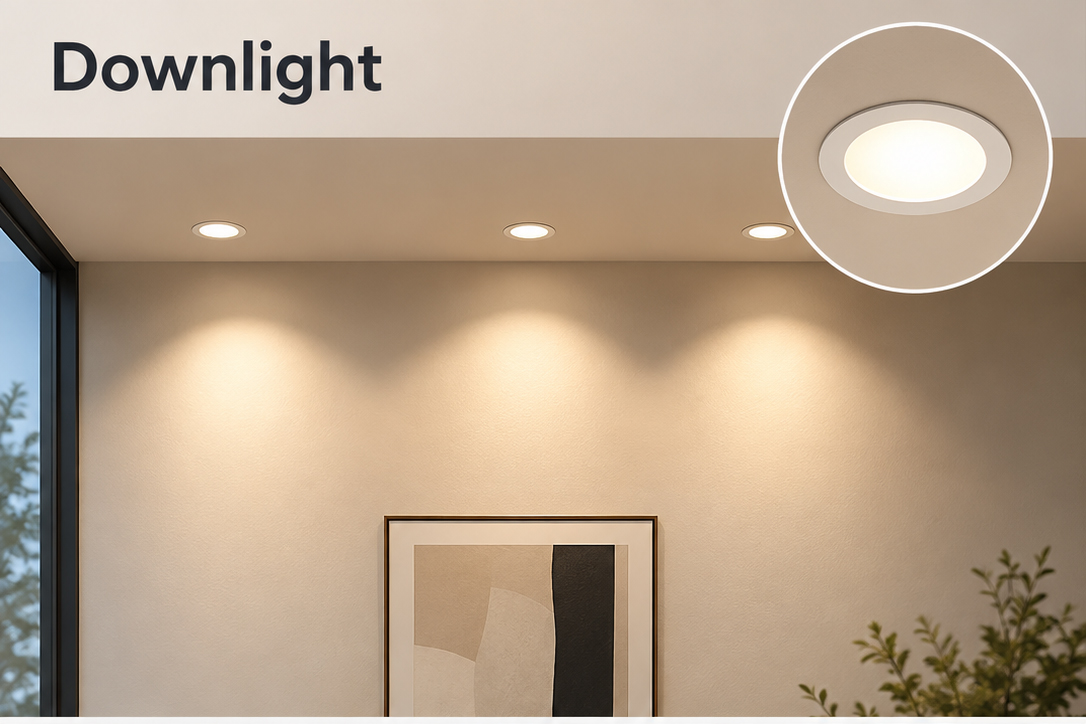
Key Features of Downlights
1. Downward Illumination
The defining characteristic of a conventional downlight is that it directs light downward. The purpose is often to illuminate a floor, table, work surface, circulation area, or general space.
2. Clean and Integrated Appearance
Many downlights are recessed into the ceiling, leaving only a small visible aperture or trim. This creates a minimalist appearance and allows the lighting fixture to integrate into the architecture. For modern interiors, this can be an important advantage.
3. Wide Range of Beam Angles
Downlights can use different beam angles depending on the intended application. A wider beam can provide more uniform general illumination, while a narrower beam can be used for accent lighting.
Therefore, beam angle alone cannot always be used to distinguish a downlight from a spotlight.
4. Different Levels of Glare Control
Visual comfort is an important consideration for downlights. Poorly designed downlights can expose the light source directly to the viewer, creating discomfort.
Professional downlights may therefore use deep-set light sources, optical lenses, reflectors, anti-glare structures, and special apertures. These technologies can help control glare and improve the visual experience.
5. Fixed or Adjustable
Many traditional downlights are fixed. However, modern architectural downlights can also be adjustable. Adjustable downlights allow the light source to tilt or rotate, making them suitable for more directional applications. This is one reason why the boundary between spotlights and downlights can sometimes become blurred.
Applications of Downlights
Residential Lighting
Downlights are commonly used as general lighting in homes. They can provide comfortable illumination in living rooms, bedrooms, kitchens, dining rooms, hallways, bathrooms, and home offices.
Offices
Downlights can provide functional lighting while maintaining a clean ceiling appearance. Glare control and appropriate light distribution are particularly important in workspaces.
Hotels
Downlights are frequently used in guest rooms, corridors, lobbies, restaurants, and other hospitality spaces. Designers can combine different downlight types to create a comfortable and sophisticated atmosphere.
Retail and Commercial Spaces
Downlights can provide general illumination throughout a store or commercial space. They can also be combined with spotlights to provide a layered lighting scheme.
Public Buildings
High-output downlights can be used in larger spaces such as shopping malls, transportation facilities, public buildings, and other commercial environments.
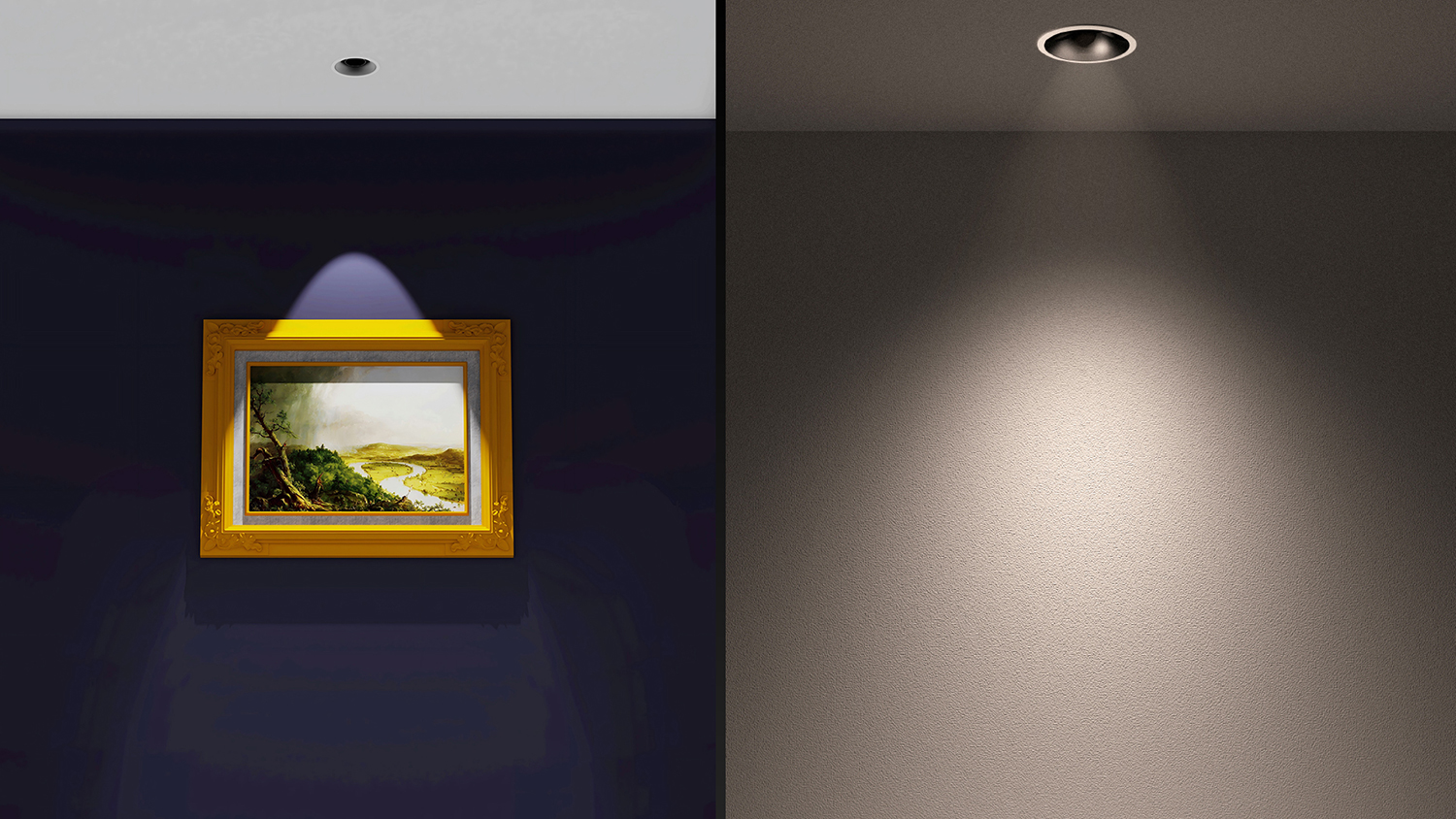
Spotlight vs Downlight: How Can We Tell the Difference?
Now we come to the most important question: how do you distinguish a spotlight from a downlight? The answer is not based on one single feature. Instead, it is better to compare them from several perspectives: lighting purpose, direction of light, adjustability, beam angle, installation method, visual role and optical design.
1. Lighting Purpose
This is perhaps the easiest way to understand the difference.
Spotlight: usually focuses attention on a specific target.
Downlight: usually provides illumination for an area or space.
For example, if a light is used to highlight a painting, it is likely functioning as a spotlight. If a series of fixtures is used to provide general illumination throughout a corridor, they are more likely functioning as downlights. However, this is a general distinction rather than an absolute rule.
2. Direction of Light
Spotlights are typically designed to project light toward a chosen direction.
Downlights generally direct light downward.
This distinction becomes particularly obvious with track-mounted spotlights, where the entire fixture can be physically aimed toward a target.
3. Adjustability
Spotlights are often adjustable. They can be tilted or rotated to change the direction of illumination.
Traditional fixed downlights are generally less adjustable.
However, adjustable downlights also exist, so adjustability alone cannot define the product category.
4. Beam Angle
Spotlights often use controlled or narrower beams to emphasize a target.
Downlights can use a wider range of beam angles, especially for general illumination.
For example: narrow beam → stronger accent effect; medium beam → localized illumination; wide beam → broader area coverage.
But again, modern downlights and spotlights can overlap in beam-angle ranges.
5. Installation Method
Spotlights are frequently installed on tracks or mounted on surfaces, although recessed spotlights also exist.
Downlights are commonly recessed into ceilings.
This makes installation appearance another useful clue.
Track Spotlight
A track spotlight can be repositioned along the track and aimed toward different targets.
Recessed Downlight
A recessed downlight is integrated into a ceiling opening and generally provides downward illumination.
6. Visual Role
Spotlights often play an active role in creating visual hierarchy. They tell people: "Look here."
Downlights are more often used to establish the overall lighting environment. They tell people: "This is the space."
A successful lighting design frequently uses both. For example, a retail store may use downlights to provide overall brightness and spotlights to highlight its most important products.
7. Optical Design
Spotlights often prioritize beam precision and directional control.
Downlights may prioritize uniformity, glare control, and comfortable illumination.
However, professional downlights can also incorporate advanced optical systems for precise beam control. Therefore, optical design should be evaluated according to the specific product rather than the name alone.
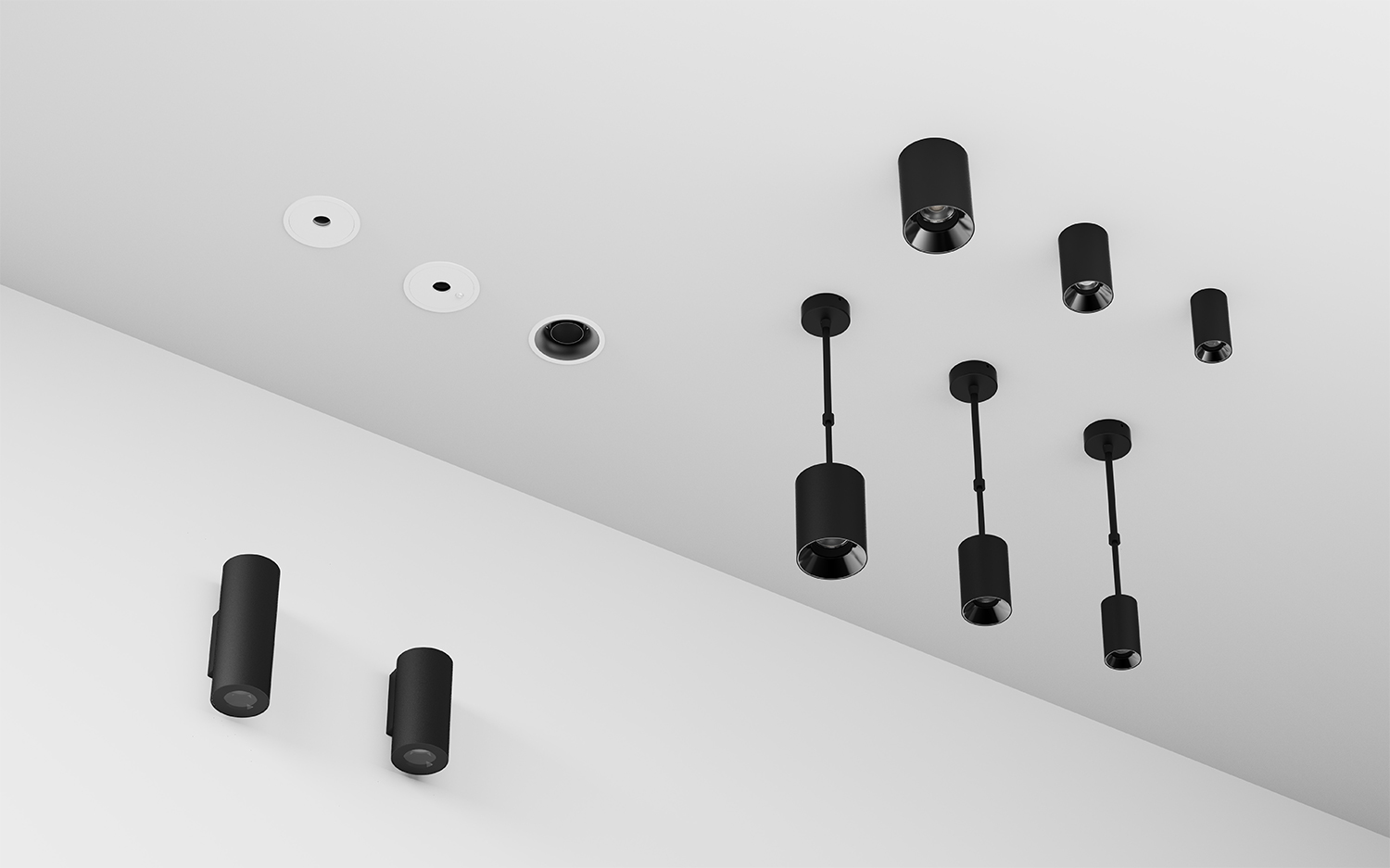
Best Spotlight and Downlight Solutions for Different Projects
For projects that require professional spotlight or downlight solutions, it is important to choose products based on lighting purpose, beam control, glare performance, installation method, and application environment. A suitable lighting solution can provide both visual comfort and a clear visual hierarchy.
For projects requiring downlighting, there are professional options such as QUEEN, GIANT, KING 2, Aurora, GENIE 2S, Brook, Prince 3, Magicube, and SPARK. These series are designed for different architectural and commercial applications, from compact residential downlights to high-output downlights for large public spaces.
QUEEN Series ultra-thin recessed downlights feature an ultra-slim 45mm housing for shallow ceiling installation. Offered in round/square, single/twin-head designs, they fit various interior styles. A 5-position DIP switch enables precise CCT tuning for premium residential and commercial lighting.
The GIANT Series high-power downlight is available in a range of sizes (from φ120mm to φ170mm), with a maximum wattage of 60W and a maximum installation distance of 10m. It is suitable for airports, subway stations, as well as other large-scale transportation hubs and high-ceiling public spaces.
KING 2 is a high-end series of deep anti-glare downlights. The all-metal housing design ensures reliability, the patented optical lens design ensures high light efficiency of 115LM/W and low glare of UGR <1, and the modular design ensures easy installation and easy maintenance.
The Aurora series wall washer downlight features an excellent deep anti-glare design with a shading angle of 100° and a narrow edge design of 4.5mm. It boasts an outstanding wall-washing optical design, offering a variety of reflector options and product size choices to meet wall-washing applications in spaces with a height of 3–6 meters. The products are applied to murals or corridor walls in luxury villas and star-rated hotels, achieving a smooth transition with the ceiling when washing the wall.
GENIE 2S Series eco downlights boast a sleek design with deep anti-glare features, a 45° shading angle, and a slim 5mm bezel. It delivers excellent illumination, gentle yet powerful, with various optical options including a narrow 9° beam angle and a high CRI of 90.
Perfect for upscale hospitality and residential use, its all-metal body ensures efficient heat dissipation while offering flexibility in installation, meeting designers' highest standards.
Brook is an adjustable waterproof downlight with IP65 protection, suitable for indoor and outdoor scenarios like walkways, airports, parking lots, and swimming pools. The recessed part is shielded by a metal casing, and the pre-wired LED power supply shares the same IP65 rating. It features excellent anti-glare performance, precise spot effect, high luminous efficiency, and flexible optical configurations, offering optimal lighting solutions for high-standard spaces.
The Prince 3 Series professional downlight, with its unique cross-beam optical design, effectively suppresses stray light, thereby creating a clear and perfectly round light spot. The floating lens design allows a single luminaire to function as both a fixed downlight and an adjustable downlight, enabling changes in illumination direction in both the vertical (25°) and horizontal (360°) planes without rotating the heat sink.
The Magicube Series mini grille light is delicate, compact, and has a linear outlook. It includes 4 optics, including a ±20° adjustable round grille, retractable spotlight, flood lighting, and wall washer, and supports recessed, pre-recessed, and surface-mounted installation. It can achieve precise accent lighting, basic lighting, and wall washing.
The SPARK Series is a professional, high-efficiency downlight with high lumen efficiency and high lumen output. It can reach a maximum of 120 lumens per watt (LM/W) at a Color Rendering Index (CRI) of 90. The series includes different versions, such as a lens version, a diffuser version, and a 3CCT dial-switch version. Additionally, it offers two types of light sources: SMD (Surface Mount Diode) and COB (Chip on Board), in various models to choose from, satisfying various needs for different applications.
FAQs About Downlight and Spotlight
Q: What Are the Main Differences Between Spotlight and Downlight Fixtures?
The main difference is their lighting purpose and light direction. A spotlight usually produces focused, directional light for a specific target, such as a product, artwork, or architectural feature. A downlight generally provides downward illumination for an area or space, such as a corridor, living room, or office. However, adjustable downlights and recessed spotlights can overlap in appearance and function, so the difference should also be judged by beam angle, adjustability, optics, and application.
Q: Which Is Better, Downlight or Spotlight?
Neither is universally better. Downlights are often better for general illumination, creating a clean ceiling appearance and providing comfortable overall brightness. Spotlights are often better for accent lighting, visual hierarchy, and highlighting specific objects. In many projects, the best result comes from using both: downlights for ambient light and spotlights for focal points.
Q: What Are the Two Types of Downlights?
Downlights can be classified in many ways, but two common categories are fixed downlights and adjustable downlights. Fixed downlights direct light downward at a fixed angle and are often used for general lighting. Adjustable downlights can tilt or rotate, making them suitable for accent lighting and more flexible lighting layouts. Other common types include anti-glare, trimless, high-output, and smart downlights.
Q: When to Choose Spotlights for Accent Lighting Over General Downlights?
Choose spotlights when the main goal is to draw attention to a specific object or area, such as retail merchandise, artwork, signage, decorative features, or a dining table. Choose downlights when the goal is to illuminate a whole area evenly and comfortably. For retail stores, galleries, hotels, and high-end residential projects, adjustable or gimbal spotlights are often used together with anti-glare downlights to create layered lighting.
Q: Which Recessed Lighting Brands Offer High-Quality Downlights and Spotlights?
When evaluating brands, look at optical design, glare control, color rendering, luminous efficacy, thermal management, and product reliability. COLORS Lighting offers professional downlight and spotlight solutions for residential, hospitality, retail, and commercial projects. For high-end downlighting, series such as KING 2, Aurora, GENIE 2S, Prince 3, and SPARK provide different optical and installation options for demanding applications.
Q: Which Brand of Downlight Is Best?
The best brand depends on the project requirements. For high-end residential and hotel projects, KING 2 offers anti-glare performance, 115LM/W efficacy, and UGR <1. For wall-washing applications, Aurora provides a 100° shading angle and deep anti-glare design. For energy-conscious projects, SPARK delivers up to 120 LM/W at CRI 90. COLORS Lighting provides high-end downlight and spotlight solutions for different architectural and commercial needs.
Conclusion
So, what is the difference between a spotlight and a downlight?
The simplest answer is: a spotlight is primarily designed to direct focused light toward a specific target, while a downlight is generally designed to provide downward illumination for an area or space.
But modern architectural lighting is more complicated than this simple definition. Adjustable downlights can perform accent-lighting functions. Recessed spotlights can look very similar to downlights. Different optical systems can also give similar fixtures completely different lighting effects.
Therefore, the best way to distinguish them is to consider:
Purpose: is the light illuminating an area or highlighting a target?
Direction: is the light primarily directed downward or toward a chosen object?
Adjustability: can the fixture be tilted or rotated?
Beam angle: is the beam broad or highly concentrated?
Installation: is it recessed, surface-mounted, or track-mounted?
Optics: how precisely does the fixture control the light?
Application: is it being used for general lighting, accent lighting, or both?
In a well-designed lighting project, there is rarely a need to choose only one. Downlights establish the lighting environment, while spotlights create visual focus. When they are combined correctly, they can transform a space from simply "bright" into visually comfortable, functional, and expressive architecture.
For designers, architects, lighting professionals, and project owners, understanding the difference between spotlights and downlights is therefore not just about identifying two types of fixtures. It is about understanding how light should be distributed, controlled, and experienced within a space.
And ultimately, that is the essence of good lighting design: not simply providing more light, but putting the right light in the right place.